
Table of Contents
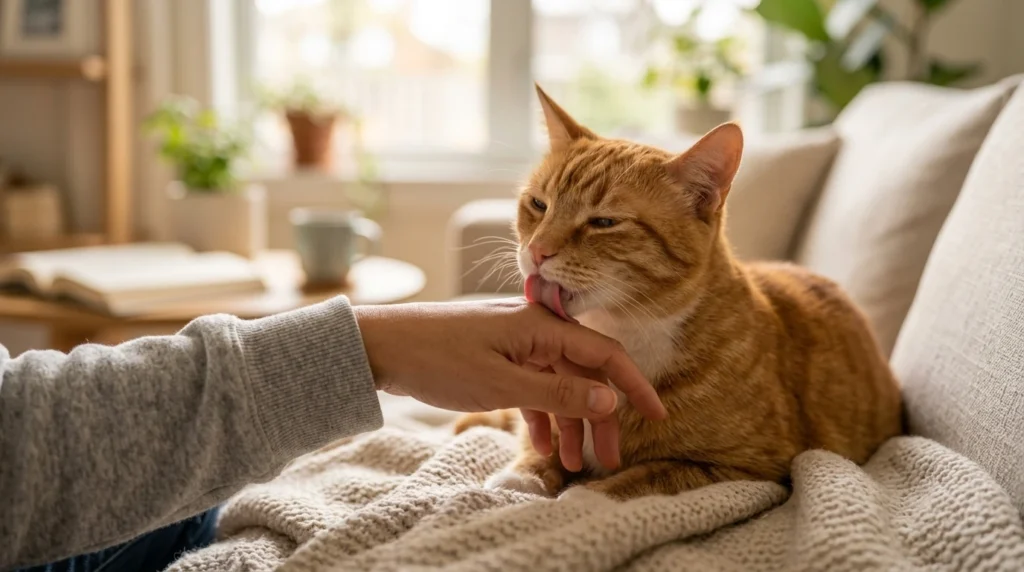
Why does my cat lick me? If you’ve ever been sitting on the couch and suddenly felt that unmistakably rough little tongue on your hand, arm, or even your face, you’re definitely not alone.
Licking is a normal part of a cat’s everyday life. Cats use their tongues to clean themselves, groom other cats they feel comfortable with, and sometimes interact with the people they trust.
So when your cat decides that you need a bath, there usually isn’t just one explanation. What it means depends on the situation, your cat’s body language, and whether this is something they’ve always done or a brand-new behavior.
Here are seven common reasons cats lick their owners, plus a few signs that may mean it’s worth paying closer attention.
Why Does My Cat Lick Me? 7 Common Reasons
1. Your cat may be grooming you
Cats don’t always groom alone. Cats that are comfortable with one another may lick each other’s head, face, and neck. This social grooming is often called allogrooming.
Your cat obviously knows you’re not another cat, but that doesn’t mean they can’t include you in some of the same social behaviors they use with other cats.
If your cat settles next to you, purrs, looks relaxed, and gently licks your hand or arm, grooming may simply be part of a comfortable interaction.
In other words, your cat may be treating you like someone who belongs in their social circle.
2. Licking gets your attention
Cats are very good at figuring out what makes their humans react.
Think about what happens when your cat licks you. You may look at them, talk to them, pet them, laugh, or move your hand. From your cat’s point of view, licking just got an immediate response.
Over time, some cats learn that a quick lick is an effective way to say:
- Pet me.
- Look at me.
- Play with me.
- Move over.
- It’s time for food.
If your cat tends to lick you at predictable times, such as before breakfast, while you’re working, or when you stop petting them, attention may be part of the reason.
3. Your skin tastes or smells interesting
Sometimes the answer to why does my cat lick me is surprisingly simple: something on your skin smells or tastes interesting.
Human skin can taste slightly salty after sweating. Food residue, soap, shampoo, lotion, and other scents may also attract your cat’s curiosity.
You may notice this more after exercising, cooking, or using a strongly scented product.
There is one important precaution: don’t let your cat lick creams, medications, essential oils, ointments, or other topical products unless you know they’re safe for cats. Something that is harmless to human skin is not automatically safe for a pet to swallow.
4. Licking may be part of your cat’s social routine
Scent plays a huge role in a cat’s world.
Cats use familiar smells to recognize animals, people, and places that are part of their normal environment. Grooming, rubbing, and resting against you can all become part of that social routine.
That’s why you may see your cat rub against your leg, lick your hand, and then curl up beside you a few minutes later.
This doesn’t necessarily mean your cat is trying to “claim” you. A better way to think about it is that familiar scent and familiar behavior help cats feel comfortable in their environment.
5. Licking can become a comforting habit
Some cats develop very specific routines when they’re relaxed.
One cat may knead a blanket before falling asleep. Another may curl up on your chest. Another may spend a few minutes licking your hand before settling down.
If the licking happens during calm, predictable moments and your cat otherwise seems relaxed, it may simply be part of a comforting routine.
You may also notice licking together with:
- purring;
- kneading;
- slow blinking;
- rubbing against you;
- curling up beside you.
If neither you nor your cat is uncomfortable, occasional licking like this usually doesn’t need to be stopped.
6. Stress can sometimes increase licking
Licking can also be a self-soothing behavior.
Cats often react to changes in their environment in subtle ways. A new pet, visitors, construction noise, moving furniture, changes in your work schedule, or tension with another cat can all affect behavior.
Stress is more commonly associated with excessive self-grooming, but some cats may also become more repetitive about licking their owners.
Look at the bigger picture.
If your cat suddenly becomes clingier, hides more often, stops playing, overgrooms, seems restless, or changes their eating or litter box habits, the licking may be only one part of a larger change.
For more examples of everyday feline behavior, read our guide to 12 common cat behaviors and what they mean.
7. A sudden increase in licking can sometimes signal a problem
Most cats that lick their owners are not sick.
Still, any behavior that suddenly becomes intense, repetitive, or difficult to interrupt deserves a closer look.
Pain, nausea, skin irritation, stress, and other medical or behavioral problems can affect grooming and licking patterns.
The most important thing to notice is change.
A cat that has casually licked your hand for years is very different from a cat that suddenly starts licking you, themselves, furniture, or other surfaces over and over throughout the day.
Consider talking to your veterinarian if increased licking happens along with:
- loss of appetite;
- vomiting or diarrhea;
- hiding more than usual;
- skin irritation or hair loss;
- pain or sensitivity when touched;
- changes in litter box habits;
- low energy;
- unusual restlessness or vocalizing.
Why Does My Cat’s Tongue Feel Like Sandpaper?
If you’ve ever received a full cat “bath,” you already know their tongue feels nothing like a dog’s.
A cat’s tongue is covered with tiny backward-facing structures called papillae. These structures help remove loose hair and debris during grooming.
That’s why one or two licks may feel funny, while repeated licking on the same spot can become surprisingly uncomfortable.
Your cat isn’t trying to scrub your skin. Their tongue is simply designed for grooming fur, not humans.
Why Does My Cat Lick My Hand?
Hands are one of the most common places for cats to lick.
They carry all kinds of interesting smells from food, soap, other animals, and the things you’ve touched during the day.
Your hands are also closely associated with things your cat enjoys: petting, feeding, treats, play, and attention.
So when your cat licks your hand, there may be several explanations at the same time, including grooming, curiosity, familiar scent, and attention.
Why Does My Cat Lick My Face?
The reasons are generally similar: social grooming, attention, familiar scent, or curiosity.
But you don’t have to let your cat lick your face just because they want to.
It’s reasonable to gently redirect them away from your eyes, mouth, irritated skin, cuts, or wounds.
You should also avoid allowing your cat to lick your face after you’ve applied skin-care products, medications, sunscreen, or anything else they could accidentally ingest.
Why Does My Cat Lick Me and Then Bite Me?
This is one of those cat behaviors that can seem completely contradictory.
Your cat is licking you calmly one second, and then suddenly there’s a bite.
One possible explanation is overstimulation. The interaction may have started out pleasantly, but your cat eventually reaches the point where they’ve had enough touching.
Look for subtle signs that may appear before the bite:
- tail flicking;
- skin twitching;
- ears moving sideways or backward;
- the body becoming tense;
- your cat suddenly turning to look at your hand.
A light nibble during grooming is also different from a hard bite accompanied by growling, hissing, tense posture, or an attempt to get away.
Context matters more than the lick-and-bite sequence by itself.
Should I Let My Cat Lick Me?
For most healthy people, an occasional lick on intact skin is generally not a major concern.
However, it’s better not to encourage cats to lick open wounds, cuts, your eyes, or your mouth.
People with weakened immune systems may need to be more cautious around pet saliva and should follow the advice of their healthcare provider.
It’s also a good idea to wash your hands before preparing or eating food if your cat has been licking them.
And remember to think about what is on your skin. Your cat can’t tell the difference between something that smells interesting and a product that could be unsafe to swallow.
How Can I Get My Cat to Stop Licking Me?
If you don’t enjoy being licked, you don’t need to punish your cat.
Yelling, spraying water, or frightening them can create stress without actually teaching them what you’d like them to do instead.
A better approach is to make your response calm and predictable.
When the licking starts, gently move your hand away or end the interaction for a moment. Then redirect your cat to something appropriate, such as:
- a toy;
- a short play session;
- a scratching post;
- a food puzzle;
- a brushing session, if your cat enjoys being brushed.
You can also reward the behavior you prefer. If your cat settles next to you calmly without licking, give them attention or petting while they’re relaxed.
With consistency, many cats learn that calm behavior gets just as much attention as licking does.
When Should You Talk to a Veterinarian?
Occasional licking on its own is usually normal behavior.
The situation is different when licking becomes excessive, compulsive, suddenly increases, or appears alongside other physical or behavioral changes.
Talk to your veterinarian if your cat is licking so much that they’re difficult to redirect, if they’re losing hair or irritating their skin, or if you notice changes in appetite, energy, digestion, urination, or behavior at the same time.
A veterinarian can help determine whether the behavior is mainly behavioral or whether pain, skin disease, nausea, or another medical problem needs to be ruled out.
The Bottom Line
So, why does my cat lick me? In many cases, the answer is pleasantly ordinary.
Your cat may be grooming someone they trust, looking for attention, investigating an interesting taste, participating in a familiar social routine, or simply repeating a comforting habit.
What matters most is knowing what is normal for your own cat.
A few relaxed licks while you’re sitting together are very different from a sudden, obsessive change in licking behavior.
Pay attention to the context, respect your cat’s body language, and take notice when a familiar habit suddenly becomes something new.
Frequently Asked Questions
Does my cat lick me because they love me?
Licking can be part of friendly, socially bonded behavior, especially when your cat is relaxed and also purrs, rubs against you, slow-blinks, or chooses to sleep near you. But licking can have several meanings, so affection isn’t the only possible explanation.
Why does my cat lick me when I pet them?
Your cat may be responding with social grooming, enjoying the interaction, or simply reacting to the attention. Watch their body language to see whether they remain relaxed.
Why does my cat lick me at night?
If it happens as part of a regular bedtime routine, licking may be a learned comfort behavior or a way to get your attention. A sudden new pattern, especially with restlessness or other behavior changes, is worth watching more closely.
Why does my cat lick me after I shower?
Your skin smells different after a shower. Soap, shampoo, moisture, and other scents may make freshly washed skin interesting to your cat.
Why does my cat lick me and purr?
If your cat looks relaxed, licking combined with purring is often consistent with a comfortable social interaction. As with most cat behaviors, it’s better to look at the whole situation instead of relying on one signal alone.
Sources
- VCA Animal Hospitals — Why do cats lick humans?
- PetMD — Why Does My Cat Lick Me?
- Cornell Feline Health Center — Cats that Lick Too Much
Educational content only. This article is not a substitute for diagnosis or treatment from a veterinarian.